✅Pinterest Affiliate Marketing: How to Get Started (Beginner-Friendly Guide 2026)
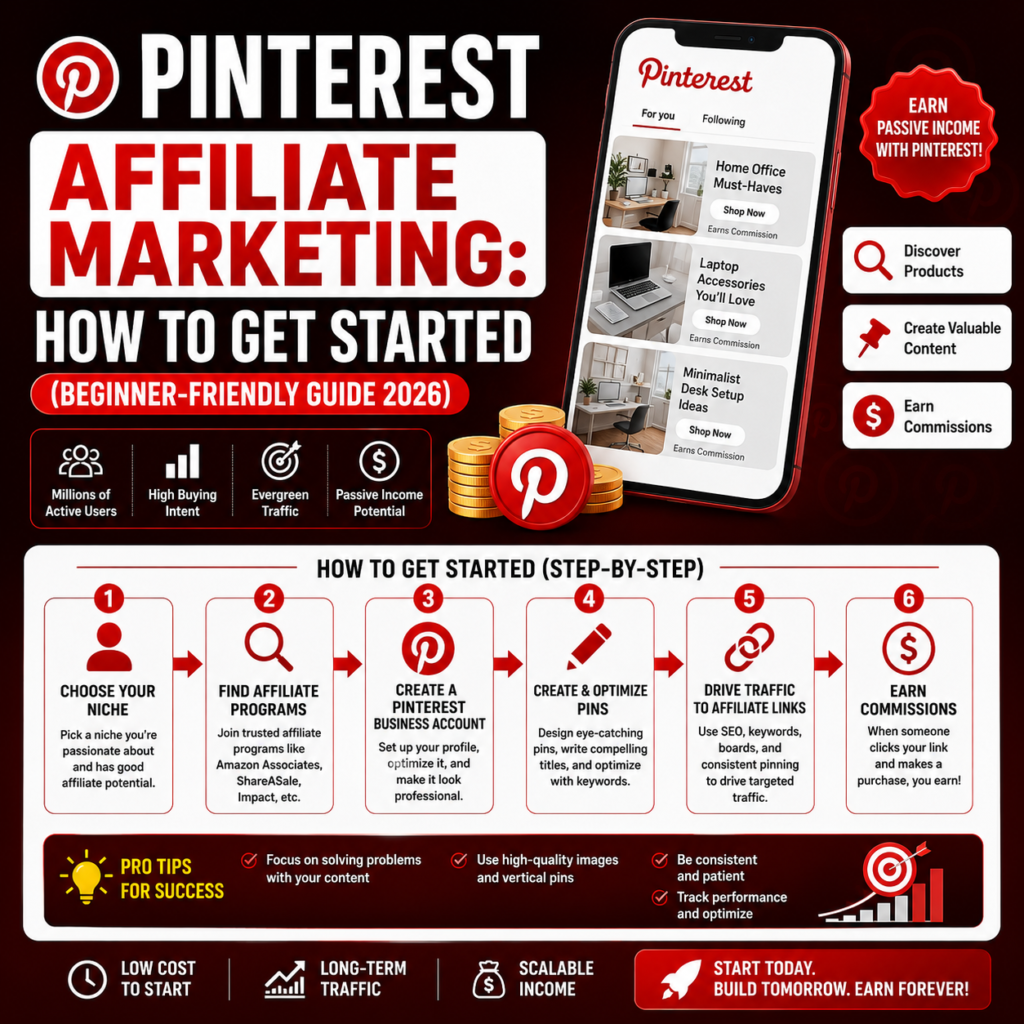
Pinterest Affiliate Marketing: How to Get Started in 2026
Meta Title: Pinterest Affiliate Marketing: How to Get Started in 2026
Meta Description: Learn Pinterest affiliate marketing step by step in 2026, from niche selection and Pinterest SEO to affiliate links, Pins, funnels, and monetization.
URL Slug: pinterest-affiliate-marketing-guide
Primary Focus Keyword: Pinterest affiliate marketing
Secondary Keywords: Pinterest affiliate marketing for beginners, how to make money on Pinterest, Pinterest SEO, Pinterest affiliate marketing strategy, Pinterest affiliate links, best Pinterest affiliate programs, Pinterest affiliate marketing without a blog, affiliate marketing funnel
Search Intent: Informational + Commercial
Introduction: Why Pinterest Is Worth Watching in 2026
If you’re a content creator, you already know how competitive digital marketing has become. Instagram is crowded with Reels, YouTube is packed with Shorts and long-form videos, and blogs compete for increasingly competitive search results. But Pinterest works differently.
Pinterest is a visual discovery platform where people search for ideas, products, solutions, inspiration, and things they may want to buy. That search-driven behavior makes Pinterest particularly interesting for affiliate marketers.
Instead of depending entirely on followers, you can create content around topics people are actively searching for and use those Pins to send relevant visitors to your website, product guides, or affiliate offers.
That’s the basic idea behind Pinterest affiliate marketing. You create useful content, publish it on Pinterest, and connect interested users with a relevant destination. If they complete a qualifying action through your affiliate link, you may earn a commission.
The important distinction is that Pinterest affiliate marketing isn’t an overnight passive-income shortcut. It is a content and traffic strategy that can become increasingly efficient as you build a library of useful content.
What Is Pinterest Affiliate Marketing?
Pinterest affiliate marketing is the process of using Pinterest content to promote products or services through affiliate programs. When someone clicks your tracked affiliate link and completes a qualifying action, such as purchasing a product, you may receive a commission according to the affiliate program’s terms.
A typical affiliate journey looks like this:
Pinterest Search → Pin → Website / Product Page → Affiliate Link → Purchase → Commission
For example, imagine you publish a WDTeck article called “10 Best Productivity Tools for Remote Workers.” You create several Pinterest Pins promoting that article. A Pinterest user searches for productivity tools, discovers one of your Pins, and clicks through to the article.
Inside the article, you explain the tools, compare their features, and include relevant affiliate links. If the reader purchases through an affiliate link and the transaction qualifies under that program’s terms, you earn a commission.
The more useful content you build around a specific topic, the more opportunities you have to attract relevant visitors.
Why Use Pinterest for Affiliate Marketing?
Pinterest can be valuable for affiliate marketers because it combines visual discovery with search behavior. People use the platform to discover products, software, travel ideas, home-office setups, fashion, recipes, productivity systems, business resources, digital products, and gift ideas.
For a technology-focused website such as WDTeck, this creates opportunities around topics such as AI tools, productivity software, SaaS products, blogging tools, website tools, marketing platforms, remote-work technology, tech accessories, digital products, and online-business tools.
Pinterest should not be treated as a guaranteed traffic or income source. Results vary based on niche demand, content quality, search relevance, competition, publishing consistency, and the quality of the destination page.
Pinterest vs. Instagram and YouTube
| Factor | YouTube | ||
|---|---|---|---|
| Main behavior | Search & discovery | Social discovery & entertainment | Search, discovery & education |
| Content format | Images, carousels, video Pins | Reels, posts, Stories | Videos & Shorts |
| Search potential | Strong | Moderate | Strong |
| Affiliate opportunity | Strong with compliant content | Depends on format and features | Strong through content and descriptions |
| Production barrier | Relatively low | Medium | Usually higher |
| Evergreen potential | High for useful content | Often more feed-dependent | High |
| Best use | Discovery & traffic | Engagement & community | Education & trust |
The goal isn’t to prove that Pinterest is better than Instagram or YouTube. The goal is to understand that Pinterest can serve a different function in your marketing system.
Pinterest can be your discovery channel. WDTeck can be your content destination. Your affiliate offers can become one monetization layer.
Step 1: Choose the Right Pinterest Affiliate Niche
Your niche determines what you can publish, which keywords you can target, and which affiliate products you can promote. A strong niche should ideally have search demand, commercial intent, visual content opportunities, relevant affiliate programs, multiple products or services, and enough topics for long-term publishing.
Technology & Software
This is a particularly strong direction for a technology website such as WDTeck. Potential topics include AI tools, productivity software, website builders, email marketing tools, SEO software, project-management platforms, cloud software, and cybersecurity tools.
Productivity
Productivity is another strong category because it naturally connects with software and digital products. Content ideas include digital planners, productivity apps, Notion tools, task-management software, time-management systems, and remote-work tools.
Blogging & Online Business
You can also build content around hosting, WordPress tools, SEO software, email marketing platforms, design tools, analytics software, creator tools, and other solutions used by bloggers and online businesses.
Tech Accessories
Physical products can complement software content. Examples include laptop accessories, mechanical keyboards, monitors, USB hubs, desk accessories, microphones, webcams, and other remote-work equipment.
Personal Finance Technology
Budgeting apps, financial software, productivity tools for freelancers, and business software can also work. However, financial topics require additional care because financial claims can be sensitive and affiliate disclosures should be especially clear.
Step 2: Find Relevant Affiliate Programs
Once you’ve selected a niche, look for affiliate programs that actually fit your audience. Consider product relevance, conversion experience, commission structure, attribution rules, refund policies, brand reputation, tracking reliability, and the program’s terms.
Common affiliate networks and platforms include Amazon Associates, Awin, CJ Affiliate, Impact, as well as individual SaaS and software affiliate programs.
Important 2026 Update: ShareASale
If you have older Pinterest affiliate marketing guides that recommend ShareASale as a standalone network, update them. Awin states that the ShareASale platform officially closed on October 6, 2025, with users transitioned to Awin.
Don’t choose an affiliate program simply because it offers a high commission. A high commission doesn’t automatically make an offer valuable. The best affiliate product is usually one that solves a genuine problem for your audience and provides a strong user experience.
Step 3: Create a Pinterest Business Account
A Pinterest business account gives you access to business-oriented features and analytics. Set up your profile around one clear topic so that visitors can immediately understand what your account is about.
Start by creating or converting to a Pinterest business account, choosing a clear profile name, writing a niche-focused bio, adding your website, and creating relevant boards. Keep your branding consistent across your Pinterest profile and WDTeck website.
For WDTeck, a focused profile could cover areas such as AI Tools, Productivity, Software, Online Business, and Tech Guides.
Step 4: Build Your Pinterest SEO Strategy
Pinterest SEO starts with understanding what people search for. Think of the process as:
Keyword → Search Intent → Content → Pin → Destination
Start with a broad topic such as “AI tools” and explore related searches and content themes. You may discover topics such as “best AI tools for productivity,” “AI tools for students,” “AI tools for small business,” “AI writing tools,” and “AI productivity tools.”
These variations can become separate content opportunities.
Step 5: Match Keywords With Search Intent
Not every keyword is equally valuable for affiliate marketing. For example, “What is AI?” is primarily informational, while “Best AI tools for small business” has stronger commercial investigation intent.
The same principle applies to product searches. “Home office ideas” is broad and inspirational, while “best monitor for home office productivity” creates a much clearer opportunity to compare products.
For affiliate content, prioritize topics where a product, service, or tool genuinely helps solve the user’s problem.
Step 6: Create Click-Worthy Pinterest Pins
Your Pin needs to communicate a clear benefit quickly. A strong Pin usually contains one clear topic, easy-to-read typography, strong visual hierarchy, relevant imagery, a compelling but accurate headline, consistent branding, and a clear connection to the destination page.
A practical starting format is the vertical 2:3 ratio, such as 1000 × 1500 pixels.
Instead of a generic headline like “AI Tools,” try something more specific such as “10 AI Tools That Can Save You Hours Every Week.” The second headline gives the user a clearer reason to explore the content.
Canva can make it easy to create multiple original Pin concepts. Test different headlines, images, layouts, and content angles instead of repeatedly publishing nearly identical graphics.
Step 7: Use Affiliate Links Responsibly
This is one of the most important parts of Pinterest affiliate marketing. Pinterest’s current affiliate guidelines say affiliate content should be original, add unique value for Pinners, and be transparent about the commercial nature of the content and links. Pinterest also prohibits attempts to manipulate its algorithms or traffic through abusive behavior.
Therefore, don’t think of affiliate marketing as simply creating a Pin, dropping an affiliate link, and repeating the process hundreds of times.
A stronger approach is:
Useful Pin → Relevant Visitor → Useful Content → Product Recommendation → Affiliate Offer
This provides more value to the reader and gives you more opportunities to build trust.
Direct Affiliate Links vs. Blog Funnel
Direct Affiliate Link
Pinterest → Affiliate Offer
Direct linking can be simple and fast, but you have less control over the customer journey and fewer opportunities to educate the visitor or build a website audience. It is also essential to follow both Pinterest’s rules and the affiliate program’s terms.
Direct affiliate links are not automatically “unsafe.” The important question is whether the content, link, disclosure, and overall strategy comply with the relevant policies.
Blog Funnel
Pinterest → WDTeck Article → Affiliate Offer
A website-based funnel is often stronger for a long-term business. For example, a Pin titled “10 Best AI Productivity Tools” can send users to a detailed WDTeck comparison article where you explain the tools, compare their features, discuss use cases, and provide relevant affiliate links.
This gives readers useful context instead of sending them directly to a sales page.
Step 8: Build Pinterest Boards Around Topics
Don’t create random boards simply to increase the number of boards. Create boards that match your actual content categories.
For WDTeck, examples could include:
- AI Tools
- Best AI Tools
- Productivity Tools
- SaaS Tools
- Online Business Tools
- Blogging Tools
- SEO Tools
- Remote Work Technology
- Tech Tips
- Digital Productivity
Use clear, descriptive board names and keep each board focused on a meaningful topic.
Step 9: Create Seasonal and Trending Content
Pinterest users often search around seasons, holidays, events, and upcoming occasions. Relevant WDTeck examples could include New Year productivity tools, Black Friday tech deals, back-to-school apps, Christmas tech gift guides, remote-work setup ideas, AI trends, and new software releases.
Pinterest Trends can help identify changing search interest and content opportunities. However, trends should complement rather than replace your evergreen content strategy.
A strong content mix is:
Evergreen + Seasonal + Trending
Step 10: Refresh and Repurpose Your Content
You don’t always need to create a completely new article to produce fresh Pinterest content. One WDTeck article can generate several different Pin concepts.
For example, an article titled “15 Best AI Tools for Small Businesses” could inspire Pins such as “10 AI Tools Every Entrepreneur Should Know,” “AI Tools to Save Time,” “Best AI Productivity Tools,” and “AI Software for Small Businesses.”
Each Pin should provide a genuinely different creative angle rather than becoming repetitive spam. Pinterest emphasizes original affiliate content and unique value.
Step 11: Pinterest Affiliate Marketing Tools
You don’t need dozens of tools to get started. A simple setup can include Pinterest Business for publishing and analytics, Canva for Pin design, Google Analytics for website traffic analysis, Google Search Console for search performance, a keyword research tool for content discovery, a spreadsheet or Notion for planning, affiliate dashboards for commission tracking, and an email platform for audience building.
A scheduler such as Tailwind can be useful if it fits your workflow, but scheduling software isn’t a replacement for good content.
Step 12: Track the Metrics That Actually Matter
Don’t focus only on impressions. Track the complete journey from Pinterest discovery to affiliate conversion.
Pinterest Metrics
- Impressions
- Saves
- Outbound clicks
- Engagement
Website Metrics
- Sessions
- Engaged sessions
- Page views
- Top landing pages
- Affiliate-link clicks
Affiliate Metrics
- Affiliate clicks
- Conversion rate
- Orders
- Commission
- Earnings per click
The most important question is: Which Pins are producing valuable traffic and revenue?
A Pin with fewer impressions but highly relevant visitors may be more valuable than a Pin with thousands of impressions and no conversions.
Step 13: Build a Pinterest Affiliate Funnel
For WDTeck, a strong funnel can look like:
Pinterest → WDTeck Article → Product / Software Comparison → Affiliate Link → Merchant → Commission
You can make the system even stronger by adding an email layer:
Pinterest → WDTeck Article → Free Tool / Checklist / Guide → Email Subscriber → Useful Recommendations → Affiliate Products → WDTeck Digital Product
This turns Pinterest from a simple traffic source into part of a larger digital-business system.
Step 14: Pinterest Affiliate Campaign Example
Let’s build a hypothetical campaign around AI Productivity Tools for freelancers and small-business owners.
The main article could be “10 Best AI Productivity Tools for Small Businesses.” From that article, you could create several Pins, including “10 AI Tools That Save Small Businesses Time,” “Best AI Productivity Tools for Entrepreneurs,” “10 AI Tools to Automate Repetitive Tasks,” and “Best AI Software for Small Business.”
The funnel would be:
Pinterest → WDTeck article → Tool comparison → Affiliate link
Track which Pins receive the most outbound clicks, which article sections receive the most affiliate clicks, and which software generates conversions. Then create more content around the topics and formats that perform best.
Step 15: Don’t Believe Guaranteed Income Claims
You may see Pinterest case studies claiming $100 in the first month, $1,000 after four months, or thousands of clicks from a brand-new account. Treat these claims carefully because there is no universal Pinterest affiliate income formula.
Your results depend on factors such as niche, search demand, competition, content quality, affiliate offer, conversion rate, website quality, traffic, and publishing consistency.
Instead of promising a specific income figure, focus on building a system that can be measured and improved.
Pinterest SEO Beginner’s Guide
Pinterest SEO can be broken down into several important areas.
1. Keyword Research
Start with Pinterest search suggestions and related topics. For example, if your main topic is “AI productivity,” you might explore related searches such as AI productivity tools, AI tools for work, AI tools for entrepreneurs, AI automation tools, and AI productivity apps.
Select keywords based on relevance and user intent rather than simply choosing terms because they appear popular.
2. Optimize Pin Titles
Make the title clear and specific. For example:
10 Best AI Productivity Tools for Small Businesses
The user should immediately understand what the content is about.
3. Write Useful Descriptions
Don’t write descriptions solely for search engines. Explain what the content covers, who it’s for, and why the reader should click.
For example:
“Looking for AI tools that can help your small business save time? This WDTeck guide compares practical AI productivity tools for writing, automation, research, project management, and everyday workflows.”
Keep the wording natural. There is no need to force a specific word count into every Pin description.
4. Optimize Boards
Use descriptive board names that accurately represent the content.
Instead of “Tech Stuff,” use “AI Tools & Productivity Software.” Instead of “Business,” use “Online Business Tools & Software.”
Clear categorization is more useful than stuffing keywords into board descriptions.
5. Optimize the Destination Page
Pinterest SEO is only half of the journey. Your WDTeck article should match the Pin headline, load quickly, work well on mobile, provide original value, use clear headings, include relevant internal links, explain affiliate relationships, and make recommendations honestly.
If a Pin promises “10 Best AI Productivity Tools,” the visitor should land on a page that actually delivers those 10 tools.
6. Don’t Depend on Hashtags
Older Pinterest guides often recommend adding three to five hashtags to every Pin. Don’t make hashtags the center of your 2026 Pinterest SEO strategy.
Focus instead on:
Relevant keywords + useful content + strong creative + accurate destination pages.
7. Measure and Improve
Review your analytics regularly and look for high-click Pins, high-save Pins, high-converting articles, strong topics, weak topics, and successful headlines.
Then use those insights to create better content.
Pinterest Affiliate Marketing FAQ
1. What is Pinterest affiliate marketing?
Pinterest affiliate marketing means using Pinterest content to promote products or services through affiliate programs. When someone completes a qualifying action through your affiliate link, you may earn a commission according to the program’s terms.
2. Are affiliate links allowed on Pinterest?
Pinterest currently allows affiliate content, but its affiliate guidelines require original content, unique value, transparency, and compliance with Pinterest’s commercial-content rules. Pinterest also prohibits artificial manipulation of traffic and other abusive behavior.
3. Is direct affiliate linking allowed?
It can be, depending on Pinterest’s current rules and the affiliate program’s terms. Direct linking is not automatically unsafe, but a website-based funnel can provide more control over the user experience and create opportunities to build your own audience.
4. Do I need a blog for Pinterest affiliate marketing?
Not necessarily. However, a website such as WDTeck provides several advantages, including more content space, SEO opportunities, affiliate comparison articles, internal linking, email capture, digital products, brand building, and multiple monetization options.
For a long-term business, Pinterest plus your own website is often a stronger model than depending entirely on direct affiliate links.
5. How many Pins should I publish per day?
There is no universal number that guarantees success. Instead of blindly targeting three to five Pins every day, focus on a publishing schedule you can maintain while creating original and useful content.
Quality, relevance, and consistency are more important than chasing an arbitrary number.
6. How long does Pinterest affiliate marketing take to work?
There is no guaranteed timeline. Some content may gain visibility relatively quickly, while other content may take considerably longer.
Factors include search demand, competition, content quality, Pinterest SEO, website quality, Pin creative, publishing consistency, affiliate offer, and conversion rate.
Think in terms of months of testing and optimization rather than expecting instant results.
7. How much can you earn with Pinterest affiliate marketing?
There is no fixed income range. Your earnings depend on:
Traffic × Click-through Rate × Conversion Rate × Commission
Even a large number of Pinterest impressions may produce little revenue if the traffic isn’t relevant or the affiliate offer doesn’t convert.
Focus on profitable traffic rather than vanity metrics.
8. What are the best affiliate programs for Pinterest?
There is no single best affiliate program. For technology-focused content, look for SaaS affiliate programs, AI-tool affiliate programs, hosting programs, SEO software programs, productivity software, tech-product programs, and affiliate networks such as Awin, CJ, and Impact.
Always check current commission structures and program terms before publishing.
9. What is an evergreen Pin?
An evergreen Pin promotes content that remains useful over an extended period. Examples include best productivity tools, home-office setup guides, AI tool comparisons, blogging tutorials, and software guides.
However, evergreen does not mean guaranteed traffic forever. Content should still be reviewed and updated when products, prices, features, or recommendations change.
10. Do affiliate links need disclosure?
Yes, when the relationship creates a material connection that consumers should know about. The FTC says affiliate relationships should be disclosed clearly and conspicuously, and the disclosure should be close enough to the recommendation or link that consumers can understand the connection.
A simple website disclosure could be:
“This article contains affiliate links. If you purchase through our links, WDTeck may earn a commission at no additional cost to you.”
Don’t rely only on vague phrases if the context doesn’t make the financial relationship clear. Also remember that laws and disclosure requirements can differ by country and audience.
Common Pinterest Affiliate Marketing Mistakes
Mistake 1: Choosing a niche only because it has high commissions
Audience-product fit matters more than commission percentage alone.
Mistake 2: Creating generic Pins
Specific headlines usually communicate value better than broad, generic claims.
Mistake 3: Keyword stuffing
Pinterest SEO should help users understand your content rather than turn descriptions into lists of keywords.
Mistake 4: Publishing repetitive affiliate content
Pinterest emphasizes original affiliate content and unique value. Repetitive or low-value publishing can work against your long-term strategy.
Mistake 5: Sending visitors to irrelevant pages
The Pin promise and landing page should match.
Mistake 6: Making unrealistic income claims
Avoid promising guaranteed earnings or specific results.
Mistake 7: Ignoring affiliate disclosures
Transparency is part of responsible affiliate marketing.
Mistake 8: Measuring only impressions
Clicks, qualified traffic, affiliate conversions, and revenue matter much more.
A Simple 30-Day Pinterest Affiliate Marketing Plan
Week 1: Foundation
Choose your niche, create or optimize your Pinterest business account, organize your boards, research keywords, select relevant affiliate programs, and identify 10–20 article ideas.
Week 2: Content
Create three to five high-quality articles or content pieces, develop multiple Pin concepts, prepare affiliate comparison content, and add relevant internal links.
Week 3: Publishing
Start publishing consistently and test different headlines, visual styles, content angles, and keyword variations.
Week 4: Analysis
Review impressions, saves, outbound clicks, website traffic, affiliate clicks, and conversions. Then identify your winners.
Don’t simply create more content. Create more of what the data tells you is working.
Final Thoughts: Build a Pinterest Affiliate Business, Not Just Pins
Pinterest affiliate marketing isn’t about creating a few attractive graphics and waiting for money to appear. The real opportunity is building a system that connects search-driven discovery with useful content and relevant products.
For a technology website such as WDTeck, that system could look like:
Pinterest → WDTeck Content → SEO + Search Intent → Useful Product / Software Recommendations → Affiliate Click → Commission
The long-term version can become:
Pinterest → WDTeck → Email Audience → Affiliate Products → Digital Products → Multiple Revenue Streams
That’s a much stronger business model than depending on one affiliate link or one viral Pin.
Start with one focused niche. Create genuinely useful content. Design original Pins around specific search intent. Send users to pages that actually answer their questions. Track what generates meaningful clicks and conversions, then improve the system month after month.
Pinterest can become a valuable discovery engine for your affiliate business—but the real asset is the content ecosystem you build behind it.
Your Next Step
If you’re starting Pinterest affiliate marketing in 2026, don’t begin by creating hundreds of Pins. Start with one niche, one audience, one content cluster, and a handful of relevant affiliate offers.
Build the foundation first, then scale what works.
Related WDTeck Guide:
📌 Pinterest SEO Beginner’s Guide